Showing posts with label History. Show all posts

Tuesday, September 30, 2014

Cliff Palace of Mesa Verde


The family and I took a great day trip to Mesa Verde National Park on Saturday to take advantage of free admission for Public Lands Appreciation day. The weather was perfect and the crowds did not seem to be too bad, but I have no previous experience to gauge that from. This was the first time I have visited the park and now I can't wait to return. We only scratched the surface of the park and much more awaits.

Saturday, July 5, 2014

Hangin' with Louis L' Amour

Louis L'Amour was an American author who wrote western stories and tales of frontier life in the Western United States. This photo was taken on his ranch outside of Mancos, Colorado. We do window cleaning on the many structures on the ranch and my imagination tends to run off across the hills and up the buttes whenever I find myself there.

Monday, June 30, 2014

Thursday, April 24, 2014

Tack Room

A building of many uses found on working ranch near Ignacio, Colorado.

Wednesday, April 3, 2013

"L" is for The Leland House

"The Pittman Apartments, built in 1927 by Durangoan P.W. Pittman, were purchased from Leland and Lola Hill in 1993. The building was renamed The Leland House in honor of the Leland Hill family, who had owned the property since 1947. Each room in the Leland House is named after an historic Durango figure and the interior décor is accented with local memorabilia, biographies, and photos of these important figures. The builder, P.W. Pittman, was not forgotten; his name dons the large family suite located upstairs in the Leland House."

ABC Wednesday for April 3rd, 2013. Please visit http://abcwednesday-mrsnesbitt.blogspot.com/  to view more participants.

*Information on the Leland House taken from The Leland House & Rochester Hotel website.

Wednesday, March 6, 2013

Emma Sweeny

The Emma Sweeny was the star of the 1950 movie A Ticket to Tomahawk. The Durango Railroad Historical Society acquired the model in August, 2011 from Amador County, California. Restoration is underway to revive the Emma Sweeny to her former Hollywood glory and interpretive signs about the history of the train and Durango's status as the "Hollywood of the Rockies" during the 1950s are on display at the Santa Rita Park in Durango.

Sunday, February 24, 2013

Baker's Bridge

The first mining camp in the Animas Valley was built on the east side of the river at this site in 1860 and 1861 by a group of 100 people under the leadership of Charles Baker. They originally called this camp Animas City, and the log bridge that was built to span the river at this spot was called Baker's Bridge. At the time, there was only minute traces of placer gold to be found in the river and the camp was under constant threat from the Ute Indian tribes in the area. As news of the Civil War finally reached the camp, most of the people living here went east. A year after the settlement began, it had dissapeared. It wasn't until fifteen years had passed that the name Animas City was resurrected as a settlement on the northern end of present day Durango.  This location was also used in the movie, Butch Cassidy and the Sundance Kid. It was in the scene in which Butch and The Kid keep asking "Who are those guys?" and make a daring leap into the river from the granite cliffs.
 This photo show the view south of the bridge.

Here is the historical marker for the site

Wednesday, January 23, 2013

Old Hwy 3

 
I took this picture last year while travelling along the Old Highway 3. Hwy 3 used to be the only road into Durango from the south and east until the larger route, Camino del Rio was built to handle the increase of traffic volume coming into the town.

Saturday, October 13, 2012

Then and Now


While you are walking down Main Ave., you may notice small placards showing a photograph of that place with historic significance.  Today I decided to make a comparison between the historic photo, and my own photo of the scene as of October 12, 2012. What do you think? Some things have obviously changed, but some have not. This was on the corner of 10th and Main. You can click the pictures for a closer look.

Saturday, May 26, 2012

Greenmount Cemetery


I took a walk through the cemetery a couple of days ago. It was the first time I have visited the graveyard and I was struck by the beauty of the well-kept grounds. It was fun to go around and look at the beautifully decorated headstones. There are some pretty old dates on some. The oldest that I noticed was around 1885.

I had a nice time visiting the graveyard, except for one little detail. As I was coming into the cemetery, I looked but did not see any signs indicating what time the gates would close. I was there just before the sun set, and as darkness fell I was starting to leave. When I got to the gate, It was locked. I couldn't believe it. I got back in my vehicle and drove up to the office, but no one was there. I drove back down to the gate and noticed there was a sign posted that said to call the police dept. if the gates were locked. Has this happened to someone before? I called and a deputy came after fifteen minutes. He opened the gate and let me out and that ended my cemetery experience.

Friday, April 20, 2012

Strater Hotel


This is one of the historic hotels in Downtown Durango. It was built in a time when it was not known if Durango would remain a mining-camp or if it would prosper as a grand metropolis. Henry Strater had the belief and vision that Durango would indeed prosper and thought it would need a grand hotel. The cost to build at the time was $70,000, but with the help of Strater's brothers and father it became a reality. Over 376,000 hand-hewn local sandstone blocks and cornices were used in the construction. Construction was completed in 1887.

The hotel proved to be a success and was very popular with locals as well as travelers. During winters, many locals would move into the hotel, closing down their own homes in favor of the well furnished and wood-stove heated rooms.

This is the first post in a series I plan to do on this historic hotel.

Tuesday, April 17, 2012

Fassbinder Park


This great, shady park in Durango is one of many, but this one has some interesting history to it.

Peter Fassbinder and his wife, Kathrine were homesteaders who came to Animas City via Silverton and Rico to the north. Fassbinder homesteaded 160 acres north of the City of Durango in 1878 and quickly subdivided it for development. His addition was filed on April 28, 1882. He built the first bridge over the Animas river connecting Durango to his subdivision, brought  fresh water to Durango from a spring on his homestead, and  later generously donated land to the City for this park, to the Catholic Church for the St. Columbia Church, and to the Sisters of Mercy for the Mercy Hospital.

Today this park is a popular place for picnics, parties, and just hanging out. This is also where the Occupy Durango movement was held last fall.

Monday, April 16, 2012

Powerhouse


Who would have thought that this small Western Colorado town was one of the first cities in the nation and world to have electric lights and grid powered by Alternating Current (AC.)

In 1892 the Durango Light and Power Company built this structure (the first known Mission-style architecture for a commercial building outside of California) to house a coal-fired  electric generator. At the time, AC was deemed to be too dangerous and was outlawed in most Eastern cities. It is because of this plant that Durango had AC powered lights available before the Great Cities of the East such as New York and Boston.

In the mid 1940s, the plant was converted from being a coal-fired plant to a gas-fired one, reflecting the West's changing emphasis on raw energy sources . Its size and adaptability made it useful long after other early power generating plants had been torn down and replaced. It eventually was acquired by Western Colorado Power, which supplied electricity to Colorado's Western Slope Grid.

The Powerhouse was shut down in the mid 1970s and was boarded up. The site, which sits on the banks of the Animas River became an eyesore and the City of Durango was trying to decide what to do with the building after acquiring it. Finding a viable use was compounded by the expensive and daunting task of removing asbestos and decades worth of pigeon droppings. Demolition was considered. The Durango Powerhouse was listed on the State and National Registers of Historic Places and became one of Colorado Preservation, Inc.'s Most Endangered Places.

In 1999 the Children's Museum of Durango (Est. 1994) was outgrowing its current space and the Museum, needing space to accommodate older visitors and yearly growth, wrote up a plan to renovate and restore the Powerhouse into an interactive science museum. The City of Durango passed a resolution supporting the rebirth of the Powerhouse as the Durango Discovery Museum. Work began in 2002 and renovation on the exterior of the building and cleaning of the site was complete in 2006.

The Durango Discovery Museum opened to the public on February 23, 2011 and the Grand Opening was held on July 17, 2011.

Monday, April 9, 2012

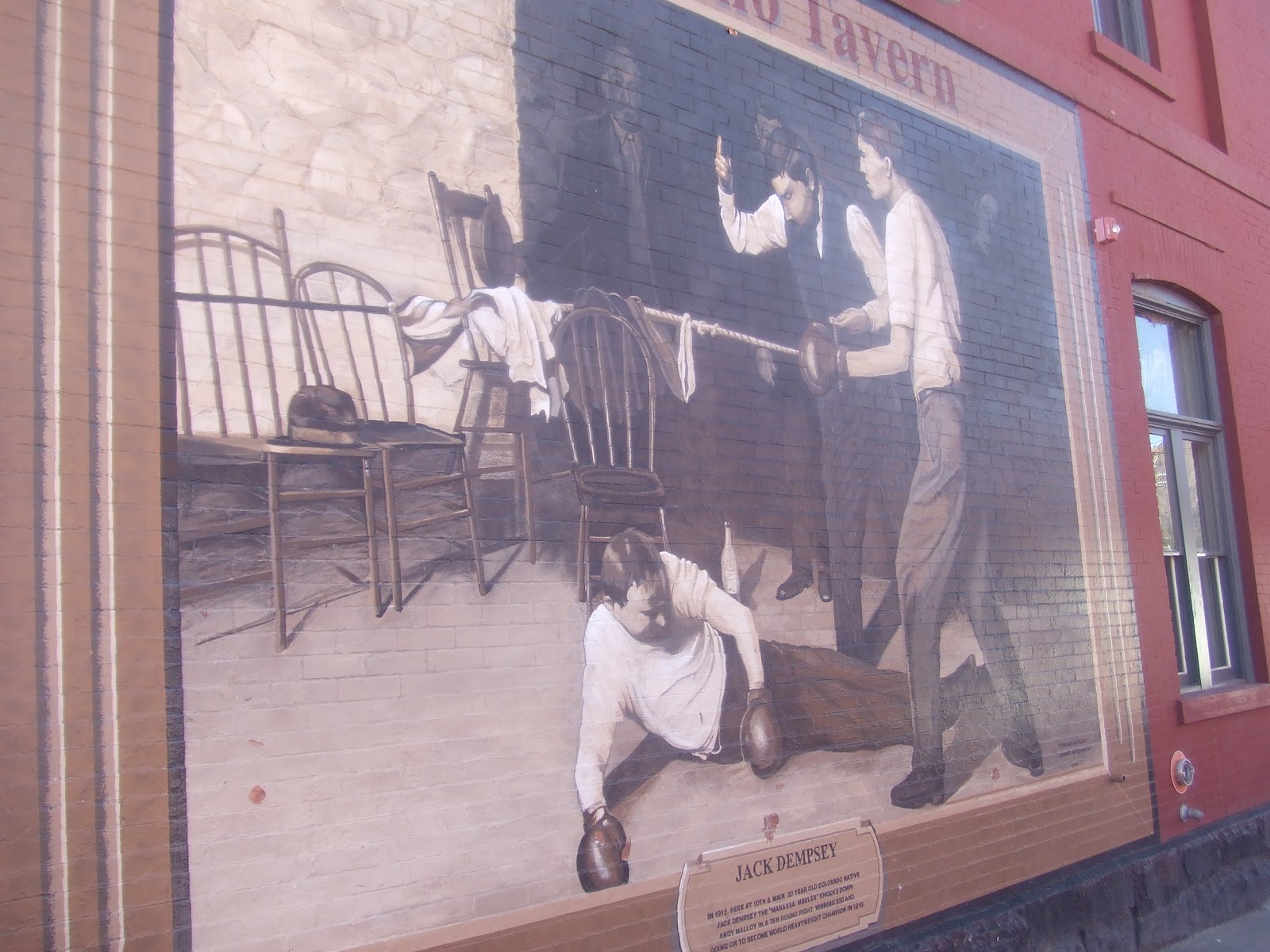
Jack Dempsey Mural


William Harrison "Jack" Dempsey, or the "Manassa Mauler" was an American World Heavyweight Champion boxer from 1919 to 1926. He was born in Manassa, Colorado. In 1915 at 10th and Main in the El Rancho Tavern, Jack Dempsey knocks down Andy Maller in 10 rounds and won $50. There is so much I could say about him but I think the Official Jack Dempsey Website can represent him better.

Wednesday, February 29, 2012

The Gable House


Durango was first established as a town in 1880, and much like the many other towns in Colorado from that time period there are many homes built with a Victorian design. This one here is called the Gable House. The Gable House today is a Bed and Breakfast establishment, but this home has a long history. It was built in 1892 by a local man who was a merchant and a flour miller named James Schutt and his wife, Eliza. For a more detailed history, visit the link above. It will take you the The Gable House's web site.
I would love to stay here for a night. I hear it is haunted too.

Tuesday, February 28, 2012

Falls Creek Archaeological Area


Falls Creek Archaeological Area lies in a hidden side valley north of Durango. In this area ancient ruins were found in 1937 and excavated in 1940 by Dr. Earl Morris whom is also known for his work at Mesa Verde.

The ruins are from the Ancestral Pueblo Basketmaker period, 1500 to 2000 years ago and are some of the earliest known ruins of that period. The ruins are found in a large alcove in the cliff side on the west side of the valley.


The Falls Creek Archaeological Area was Created in 1993 and encompasses 1,500 acres of land. The area west of County Road 205 is closed to protect the ruins, but there is an extensive network of trails on the east  in the flat valley bottom.

Monday, February 27, 2012

Animas City Museum

Before the town of Durango was a reality, there was a small town that inhibited the Animas River Valley on the northern end of modern Durango. It's official designation as a townsite was recorded in 1876, and by August of 1877, Animas City had 45 houses, 150 people, four stores and a post office. Animas City enjoyed steady growth until 1880, when the Denver & Rio Grande Railroad decided to build it's own town, Durango, just less than a mile downstream. While Animas City could not compete with this new town to it's south, it did not just vanish off the maps.There where a handful of hardy individuals who chose to stay, and the two towns sat side by side through the early1900's, the Great Depression, and World War II. After the war, however, there was a growth spurt in population and a housing shortfall that eventually brought Animas City to it's end. Animas City was annexed to City of Durango on January 1, 1948.


This building houses the Animas Museum. It was built in 1904-05 and was the Animas City School